Showing posts with label Camera Work. Show all posts
Showing posts with label Camera Work. Show all posts
Monday, 13 January 2014

Friday, 15 November 2013
9 Shot Analysis #2
Shot 1:
 This lasts for a very long time (21s) and has the normal 20th Century Fox soundtrack to back it.
Shot 2:
 This lasts for 11 seconds and has an upbeat soundtrack to back it.
Shot 3:
 This last for 2 seconds and sets up that the film is going to be about a wedding. We see a child's box covered in scrap paper to make it look home made. This shot slowly zooms into the box and then fades to the next. The sound continues from the previous shot. You could say that this is from a child's point of view
Shot 4:
 We now get the first section of text and the shot shows a hand opening the box. The camera is still and the music continues. This is also from a child's point of view.
Shot 5:
 In this shot we see the box being opened to reveal a lacy material which the audience can only guess is a veil. The music continues and we get more text on the screen. A hand then comes into shot and removes the veil from the box and the shot fades out. This lasts for 3 seconds. Continues as a child's point of view
Shot 6:
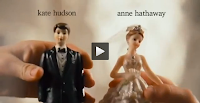 We now see some cake toppers of a bride and groom with actors names. The child is playing with them and moving them towards the camera. This shot lasts for 3 seconds and then fades to the next shot. Again this is from a child's point of view.
Shot 7:
 We now see the child colouring in a picture of two brides along with the title of the film 'Bride Wars' the camera is generally still with a very slight movement . The music continues and this shot lasts for 4 seconds. This is also from a child's point of view.
Shot 8:
 This is also from a child's point of view. It shows someone playing with the bride and groom cake toppers shown in shot 6. The music continues and the shot lasts for 3 seconds as it pans across the toppers and shows a credit.
Shot 9:
 This shot lasts for 3 seconds, it firstly fades in and is again from a child's point of view. It shows the child's hand digging into the box to find something. The music continues as before, it then fades out to the next shot.
 This lasts for a very long time (21s) and has the normal 20th Century Fox soundtrack to back it.
Shot 2:
 This lasts for 11 seconds and has an upbeat soundtrack to back it.
 Shot 3:

Shot 4:

Shot 5:

Shot 6:

Shot 7:

Shot 8:

Shot 9:

9 Shot Analysis #1
 Shot 1:
This shows the name of the location where the action takes place and also emphasises 'for young ladies' which the viewers will soon discover is not true. The sound is a backing track of the 'St Trinians Theme Song'. The camera is still then pans around to show a skull on a stick which already contradicts the 'young lady' aspect of the school. This lasts for 4.5 seconds.

This shot is a view from the back seat of a very fancy, posh Rolls Royce which is driving along a road. We see mans back and a reflection of his sunglasses in the rearview mirror. He looks across at someone in the seat next to him who we cannot see yet. The music continues to be the same. This shot lasts for 1 second so the film seems to pick up pace here compared to shot 1.

We now find out that the passenger is a young girl. Presumably his daughter from the same backseat viewpoint as before. She also looks back at her father which creates an enigma as the audience are not quite sure who these people are. The music continues as before and this shot lasts for 2 seconds.

This shot shows the car carrying the girl and man and shows a viewpoint of possibly a watcher or just an overview of the surrounding countryside location. The music continues as before.The shot lasts for 5 seconds and pans along with the car whilst it is moving.

This again show the location and the countryside in which the fancy car is driving through. It pans along with the movement of the car to show it travelling through some big metal gates. The music continues and this shot lasts 7 seconds which is quite long.

This shot seems to be on the ground showing the back of the car. It gives the idea that the people in the car are arrogant and upper class due to the height of the camera and the exhaust fumes blowing right in the camera. The music again continues whilst the camera pans along to show a very old, grand building whilst moving towards it.

This shot shows that the passengers are getting out of the car because they have arrived at the destination and they are getting their luggage out which indicates that they are intending on staying. The emphasis on the closing of the boot shows this. This shot lasts for 1 second. The sound continues as before as well as a prominent sound of the boot closing.
 Shot 8:
This shot is quite a long shot which lasts 11 seconds, you see that they 2 main characters have both got out the car and carrying luggage. You see the girl in school uniform which shows that she is going to a school. There is some dialogue in this clip as well as a desk falling from the sky (a window) and the flutter in sounds of paper falling from the desk. The backing music remains as before.
 Shot 9:
We now see the characters opening a door and entering into a room with a very suspicious box saying 'Deposit all contraband items here' which causes the characters to look scared worried. The camera pans around the room along with them walking and the girl complains that it is 'low rent'. The background music continues as before.
Sunday, 10 November 2013
Key Conventions of A Chick Flick
Chick Flick Films are:
- Generally aimed at a female audience as the characterisation and storyline appeal to them.
- Usually a female protagonist who has to overcome a problem (commonly between money or love)
- An 'unavailable' man is essential in these films due to the love theme and the attraction of women.
- The male character is usually described as a heart-throb
- They are commonly tear jerking films
- The protagonist is an empowered woman
Wednesday, 2 October 2013
The Last King of Scotland
This is what I learnt about filming in lots of locations and the uses of colour:
-Filming in lots of different locations, especially in a vehicle like in this extract, it can show time passing as the different locations can be shown by movement. It also can show development as in this extract, from really undeveloped communities to a very smart house. This is an effective method of showing these concepts as it can be shown in a matter of seconds and moves the scene along effectively.
- The colour used can largely provide the atmosphere of the scene. For example, dark colours could suggest a sad or scary moment, bright colours could suggest a happy moment
-Filming in lots of different locations, especially in a vehicle like in this extract, it can show time passing as the different locations can be shown by movement. It also can show development as in this extract, from really undeveloped communities to a very smart house. This is an effective method of showing these concepts as it can be shown in a matter of seconds and moves the scene along effectively.
- The colour used can largely provide the atmosphere of the scene. For example, dark colours could suggest a sad or scary moment, bright colours could suggest a happy moment
Tuesday, 1 October 2013
Monday, 30 September 2013
Mise En Scene Issues
Mise En Scene
The Issues I might encounter when I make my own film opening:-Location= Finding somewhere to film may be difficult. E.g. If we want to go far away, how will we get there?
- Costume- What costumes are appropriate for the genre that I choose? Colours appropriate?
-Actors- Who will I cast to be in my opening? Do I need extras?
- Props- Do I have the correct and appropriate props for the genre/ at the location? Do I need more/less props?

Monday, 9 September 2013
Principals of Continuity
Today we learnt about the principals of continuity and began to prepare for a short film using them. Here they are with an explanation of each:
1. Match on Action
This is when the shot is cut from one area of the scene to another to show what is happening in another view that matches the first shot. It gives an impression of continuity.
2. Shot Reverse Shot
This is when one character is looking at another and the camera shows this from behind one of their heads. This then changes to behind the other persons head so that we get a view of both the characters. It is to show two characters looking at each other.
3. 180 degree rule
This is when the camera is not shown more than 180 degrees around the two characters having a conversation. If more than 180 degrees is shown then it may look like the characters have suddenly moved and then it becomes noncontinuous.
Emily
1. Match on Action
This is when the shot is cut from one area of the scene to another to show what is happening in another view that matches the first shot. It gives an impression of continuity.
2. Shot Reverse Shot
This is when one character is looking at another and the camera shows this from behind one of their heads. This then changes to behind the other persons head so that we get a view of both the characters. It is to show two characters looking at each other.
3. 180 degree rule
Emily
Saturday, 7 September 2013
Cinematography
Yesterday we watched some clips and had to comment on the cinematography, here they are along with my comments on the cinematography used:
1. John Lewis Home Insurance Advert 2013
2. Chicken Run Introduction (The only decent clip I could find on Youtube! From 6:54)
3. Wallace and Gromit: The Curse of the Were-Rabbit ( I can't find a clip!)
1. John Lewis Home Insurance Advert 2013
I LOVE this advert!
-It uses animation to create the effect that the objects in the house are moving outside for a family photo.
- Uses close ups, panning, high shots, low shots, zooming, medium shots and long shots
- I love how it seems that the furniture and household items come to life and begin to move alone.
- Animation like this could be used in my film introduction however it may be very difficult and time consuming to do it on such a big scale.
- This animated film personifies the chickens to make us be able to relate to them more, for example some wear glasses and are knitting.
- The sky is shown a lot and is constantly changing colour to reflect the situation. For example when the 'General' Chicken is shouting he is in the place of the sun which suggests that he thinks of himself as very important. As if he 'is' the sun. Then when Miss Tweedy walks towards the chickens the sky is a fiery red which shows that she is dangerous and something bad is going to happen. Then when she stands still the sky turns very dark to show that she is a dark, cruel character.
- The 'General' Chicken is based on a WW2 army leader, how he is so powerful and loud, but also by how he speaks and dresses suggests this.
- Shots used are: From a chickens point of view, Aerial shots, low shots to show power to Miss Tweedy, high shots to show Edwina as very vulnerable, also a shot from very low is used to show Miss Tweedy's wellies, this shows how she is the leader and very scary for the chickens (also it is from the their point of view). The shot of Miss Tweedy's boots through the chicken wire shows how the chickens are trapped in somewhat a prison. She then seems to walk over the camera which shows her power. Finally at the end of the clip a silhouette of Mrs Tweedy and Edwina is shown which shows what the chickens would be seeing and also creates a scary, spooky, 'ghost-like' atmosphere.
- Lots of close ups of Ginger are show at the end of the clip which not only shows that she is a main character in the film as a whole but the audience get to see her emotions, she knows what is happening to Edwina as she holds her neck. By showing her like this the audience can tell that she wants something to change.
- In my film introduction I would like to film as if from the characters point of view as this is a very effective way of cinematography. Another thing that I may use is a silhouette shot as this would be brilliant for a thriller film due to the atmosphere it creates.
- This clip showed lots of different types of cinematography such as long shots and medium shots.
-I like again how the moonlight creates silhouettes in the room which creates a spooky atmosphere, suggesting something may go wrong
- In this clip I would like to use the silhouettes as I said above because they look really effective in a thriller or scary film
Emily :)
Subscribe to:
Posts (Atom)